About:
Exploring new approaches to machine hosted
neural-network simulation, and the science
behind them.
Your moderator:
John Repici
A programmer who is obsessed with giving experimenters
a better environment for developing biologically-guided
neural network designs. Author of
an introductory book on the subject titled:
"Netlab Loligo: New Approaches to Neural Network
Simulation". BOOK REVIEWERS ARE NEEDED!
Can you help?
Other Blogs/Sites:
Neural Networks
Hardware (Robotics, etc.)
|
Sunday, August 1. 2010
There's an interesting article at the Talking Brains blog that gets our bearings and discusses our current understanding of the relationship between Broca's area and speech. If you are still of the old notion, that it is the area that —working with Wernicke's area— is singularly responsible for syntactical construction of sentences (as I was), this will be a worthwhile read:
20100527: Syntax found in the brain -- not in Broca's area
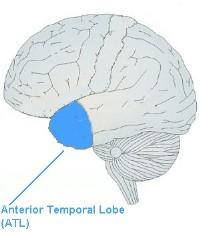
BA15? No, not BA15. [note 1]
|
The above blog post gives a good overview with a nice sequence-line of how we got from the old understanding to the new (it has been a progression). It then puts a nice bow on the whole thing by describing a new study that provides strong observational evidence for the notion that the anterior temporal lobe has—at least—something to say about processing language and grammatical structure.
This is just my take (which could be very wrong), but I think what has been going on here is that understanding of the brain has been refining our understanding of linguistics, which has in turn, been refining our understanding of the brain. . . But that situation may be changing.
Grammatical rules, while being a nice way to talk about sentences, may not be something for which there is a directly correlated, and nameable brain structure. Again, it's just my hunch, but the connections between verbal communication and things like metaphor, and even dance (with the help of the brain constructs now believed to effect metaphor) seem to be part of what is becoming a much more complete understanding of the processes underlying speech. Our facilities for making metaphorical-conceptual connections between verbal communications, other forms (modes) of stimulus, and other forms of physical expression, seem to be emerging as the underlying causes of grammatical structure.
As our knowledge of the underlying brain mechanisms grows, sentence-structure is looking more like the old clockwork models of the solar system and universe. It is an abstract system of notation which was designed and developed to let us represent and model observable characteristics of the language itself. The language being modeled, however, was merely the end result of underlying processes that were (like the laws of gravity and motion in days past) totally hidden from us.
Understanding of language structure will be updated by our—now exploding—understanding of its causes. Of that I have no doubt. Right now, however, there seems to be a non-linear jump in what we're learning about the brain processes that lead to grammatical sentence structure.
-djr
. . . . . . .
Also:
= = = = = = = = = = =
NOTE 1. - Perhaps BA15
Sunday, July 18. 2010
This entry explores a cross-section of excerpts from the book. The cross-section, in this case is: the need for neural networks to interact with a complex external environment.
"Milieu, An External Environment:
Last but certainly not least: the population of similar cells simply could not learn, or exhibit any of the behaviors described, if they had no external environment with which to interact. This clearly axiomatic observation is so taken for granted in studies of biological organisms, that it is often overlooked when modeling them."
"On the other hand, consider the abstract concept of pure unsupervised learning. In a practical sense, this isn't really possible or doable either. If you place a learner directly into an isolation tank at birth, it will not learn. "
"...Of course, when the system is adaptive, and the external environment sits directly in the feedback path [diagram], this relationship can be stated in the opposite direction as well. That is to say, it is simultaneously about making output signals more consistent for each given set of input stimuli. Essentially, if we take both directions into account, it is the world changing the network, changing the world, changing the network, ... ad infinitum."
. . .
"To summarize, feedback loops of signals originating in the brain and returning can remain inside the brain, go outside the brain but remain inside the organism, or include complex chains of causal activities completely outside of the organism."
"We have seen that we can not expect a biological learning entity to learn anything, if we simply place it directly into an isolation tank at birth. We shouldn't expect anything that we build to exhibit sentient behaviors either, if we don't give it the ability to be an integral, interacting part of the complex world around it. Without such interactive capabilities, anything we build will have a restriction that is functionally identical to a biological organism in an isolation-tank. Even if all other facilities to support consciousness are in place, it will not be capable of using them, if denied the ability to interact with a complex milieu."
|
|
Netlab Loligo - New Approaches to Neural Network Simulation
—
This is the book. If you have an interest in machine hosted neural network simulations and have been looking for something that radically departs from the current list of formulaic, paint-by-numbers approaches, this book may be just what you've been looking for. It is in stock and shipping now, if you would like to check it out now, prior to the press-release being distributed. It is also available from Amazon.com
Not sure? Check out the excerpts pages for a little bit of a peek into the book.
|
Friday, July 2. 2010
It's always about the actuators these days, isn't it? In the broadest sense, actuators are anything that can convert a signal into a physical motion or force. In a more practical sense, actuators are the “muscles” used to provide controlled motion to robotic systems. Robots and adaptive systems are able to manipulate physical objects around them by controlling the motion of actuators in specific ways. Likewise, they use actuators to manipulate themselves, as objects, relative to the objects around them.
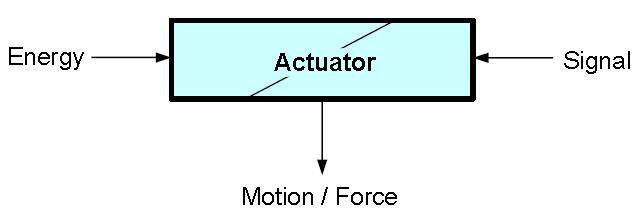
This article explores the subject of actuators at a very introductory level. It is written by a programmer, who is trying to learn some of the details about what the robotics folk are up to, in order to organize those details into a more coherent understanding.
Monday, June 21. 2010
And so too, it would seem, are our thoughts...
- Metaphoric intelligence and foreign language learning - Jeannette Littlemore
"Metaphor is so pervasive in language that it would be impossible for a person to speak without using metaphor at some point, whether knowingly or not."
- The Contemporary Theory of Metaphor - Lakoff, G.
"...a great many common concepts like causation and purpose are metaphorical..."
- Cognitive linguistics - Terri Eynon
"Until relatively recently it was assumed that it must be possible to provide an accurate, objective (i.e. literal) description of reality for the purpose of scientific advancement. For the modernist, metaphors characterized rhetoric, not scientific discourse. "
- Cognitive Linguistics - George Lakoff
"It was discovered in the late 1970's that the mind contains an enormous system of general conceptual metaphors -- ways of understanding relatively abstract concepts in terms of those that are more concrete."
- Metaphor - a Working Concept - Olle Torgny
"On the other hand, abstract products and services, computer software, medication, electronics and similar phenomena has an ”inner structure” that is dependent on specific domain knowledge or that even is incomprehensible for experts. In this case the properties of the product (object, service, concept) has to be conveyed by something else.
The more complicated and abstract this message is, the better suited is the use of metaphor."
- Oral Metaphor Construct (OMC) - Asa M. Stepak !
This guy has a very interesting theory. It is also relatable at a lower abstract level than most. That is, it may provide implementable understanding about neural networks at the signaling level, where neural-network constructs live. For now this is just an interesting aside I found while researching. It (for me at least) merits a closer look.
- Standford U. Lecture: Analogy as the Core of Cognition - Douglas Hofstadter
A fairly decent talk on a very important subject.
- Related Blog Entries:
Friday, June 11. 2010

|
"Red sky in morning, sailors take warning"
|
From the vantage point of the observer, the red sky occurs before the storm, and, in fact, can be used to predict it. Does the red sky, therefore, cause the storm, or does the storm (which comes later) cause the red sky? This is not really a difficult question to answer, but it does nicely demonstrate some of the pitfalls to be aware of. This is especially true when observing cause-and-effect in phenomena that are closer to the limits of our current understanding. In short, there is more to observing cause-and-effect than apparent sequential precedence.
The Pharisees to whom Jesus spoke about this ( Mathew 16:1-3) clearly knew of it as a rule of thumb, or common knowledge. Did they, as individuals, discern the true causal direction back in Jesus' day? Perhaps, but there was likely a time in our knowledge of this, that we did not know. In other words, there may have been a time when we only knew that there was a correlation, and that the red sky came first. In those times, all but the deepest thinkers probably thought of the red sky as causing the storm which came after it; even if only tacitly, because they never really gave it much thought.
Obviously, in this day of radars, and satellite-pictures, our observational vantage-point has expanded well beyond this particular problem. It is probably true, however, that many newer observed correlations, as well as many observations throughout history have a similar local-sequential characteristic early-on. One can certainly understand, for example, how it would have been easy to conclude that the heavens revolved around the earth. This tendency, which may include correlation with no, or wrong, causal direction, probably continues to occur in many present-day, cutting-edge observations.
[Read more...]
Tuesday, June 1. 2010
We seem to be advancing rapidly on what can best be described (metaphorically), as the brain-function correlates of metaphor and analogy. Synaesthesia—mistaking sound for color, or perceiving numbers as having colors, etc.—may, in fact, be a characteristic of basic, inherent functions and structures, which are common in all brains. The determining factor may be only a question of degrees.
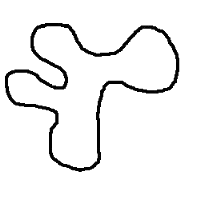
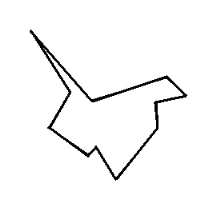
One of the following alien-alphabet symbols is named “Woobul,” and the other one is named “kitkit.” Take your best guess to answer the question: which one is kitkit, and which one is woobul?
A
|
B
|
If you're like over 90% of respondents, you have guessed that 'A' is woobul and 'B' is KitKit. Why aren't the responses to this question around 50/50 for either symbol? According to Vilayanur Ramachandran, who used the above demonstration in his talk, what you are seeing in these responses is, in fact, the same mechanism that leads to synesthesia [1]. It is, obviously, a bit less pronounced in most people compared to those whom we would classify as having synesthesia.
[Read more...]
|

|
 Stand Out Publishing


